
Last Updated: 19 January 2026
Can Fin Homes is one of the best companies in the housing finance sector of India. Today, in this article, we will discuss how Can Fin Homes share price target will perform between 2026 to 2050. We will analyse in detail not only the share price target but also the company’s business, fundamentals, technical, financial performance, peer and why the share price may increase in the future.
Can Fin Homes Share Price Target (2026 to 2050) – Quick Overview
| Year | Minimum Price | Maximum Price |
|---|---|---|
| 2026 | ₹868 | ₹1,175 |
| 2027 | ₹1,105 | ₹1,486 |
| 2028 | ₹1,338 | ₹1,812 |
| 2029 | ₹1,657 | ₹2,205 |
| 2030 | ₹2,020 | ₹2,656 |
| 2035 | ₹3,384 | ₹4,225 |
| 2040 | ₹4,849 | ₹6,010 |
| 2050 | ₹9,300 | ₹12,155 |

What is Can Fin Homes Ltd? (NSE: CANFINHOME, BSE: 511196)
Canara Bank established Can Fin Homes Limited on October 29, 1987. The company is already registered with the National Housing Bank (NHB). Currently, the largest shareholder of the company is Canara Bank, which holds about 29.99% of the shares. Although the company keeps housing loans as its main focus, it also maintains a diversified portfolio of offerings fixed and cumulative deposits, top-up loans, mortgage loans and non-housing financing solutions, etc.
This company generally provides loans to middle-class working Indians. Their loan amounts are also quite small. For example, if someone takes a loan to buy a house, the average amount is around Rs 25 lakh, while the average loan amount for other needs (which are not related to housing) is around Rs 8 lakh. At present, the company’s total loan book size is over Rs 39,658 crore.
Can Fin Homes Share Price Today (LIVE Chart)
Can Fin Homes Share Price Target Analysis (2026-2050)
In this section, we analyse the projected share price targets of Can Fin Homes from 2026 to 2050 based on loan growth, profitability trends, branch expansion and long-term housing finance demand in India.
Can Fin Homes Share Price Target 2026
Can Fin Homes management aims to disburse another ₹10,500 crore in fresh loans in FY 26, which is expected to increase its total loan volume and AUM by around 12% to 13%. Currently, it has a total of 248 branches across 21 states and union territories, but the management wants to open 15 more branches by 2026, taking the total branch count to 263. This branch expansion will increase market reach, increase loan availability among customers and accelerate overall business growth. Based on branch expansion, loan book growth and business growth, the potential Can Fin Homes share price target for 2026 is estimated to be between ₹868 to ₹1,175.
| Month | Minimum Price | Maximum Price |
|---|---|---|
| January | ₹868 | ₹960 |
| February | ₹915 | ₹970 |
| March | ₹931 | ₹988 |
| April | ₹943 | ₹1,012 |
| May | ₹957 | ₹1,033 |
| June | ₹966 | ₹1,048 |
| July | ₹979 | ₹1,064 |
| August | ₹995 | ₹1,082 |
| September | ₹1,010 | ₹1,103 |
| October | ₹1,027 | ₹1,129 |
| November | ₹1,043 | ₹1,144 |
| December | ₹1,064 | ₹1,175 |
Can Fin Homes Stock Price Target 2027
The company has 39 sales team members, which is expected to increase to over 100 dedicated sales team members by 2027. Can Fin Homes’ primary business model is Direct Selling Agents (DSAs). In this model, the agent deals directly with the customer, which results in the agent paying a commission, and the company is dependent on the agents. Since a large portion of sales comes from this model.
Therefore, to reduce the dependence on these agents, the company has started working on a direct sourcing model. If this model works successfully, it will be possible to deal with direct customers. As a result, customer acquisition cost will be lower, and loan quality will be better, which will improve ROA (Return on Assets) in the long term, which can have a positive impact on the stock.
Also, the management has informed that the AUM growth, which is estimated at 12% to 13% in 2026, may increase to more than 15% in 2027. Considering the increase in the sales team, reduction in dependence on agents and good AUM growth, it is estimated that Can Fin Homes share price target may be between ₹1,105 to ₹1,486 in 2027.
| Year | Minimum Price | Maximum Price |
|---|---|---|
| 2027 | ₹1,105 | ₹1,486 |
Can Fin Homes Share Price Forecast 2028
Most of the company’s business, about 54%, comes from South India, and the company is facing some challenges in the South, especially in Karnataka and Telangana. Therefore, the management wants to expand in North and West India, especially in these states (Uttar Pradesh, Gujarat, Maharashtra, Madhya Pradesh, Rajasthan), which will diversify the loan book, reduce dependency on one place, and strengthen long-term growth.
Also, the management’s target is to reach the milestone of a total of 300 branches by 2028. The company’s vision is to expand its business to the rest of India and increase the number of branches evenly. Due to these reasons, the Can Fin Homes future stock price in 2028 is estimated to be between ₹1,338 to ₹1,812.
| Year | Minimum Price | Maximum Price |
|---|---|---|
| 2028 | ₹1,338 | ₹1,812 |
Can Fin Homes Future Stock Price 2029
Can Fin Homes primarily provides home loans to the common man and middle-class families in India, especially those who are looking to buy their own home for the first time. The company’s largest customer base is the employed and salaried middle-class families, and this segment generates about 72% of the company’s revenue. The company’s NPA is much lower because of lending to job seekers, as most of this segment repays its loans properly.
The company also provides loans to self-employed non-professionals (SENPs) such as shopkeepers and small business owners by looking at their IT returns and business records. The company’s target is to increase its revenue generation from 28% to 35% by giving more loans to self-employed borrowers. The company focuses on Tier-2 and Tier-3 cities where the demand for home loans is increasing steadily. Given the company’s targeted customer base and focus on Tier-II and Tier-III cities, it is estimated that Can Fin Homes share price forecast may be between ₹1,657 to ₹2,205. in 2029.
| Year | Minimum Price | Maximum Price |
|---|---|---|
| 2029 | ₹1,657 | ₹2,205 |
Can Fin Homes Share Price Target 2030
India’s housing finance market is expected to reach over $765 billion by 2030. The entire sector is expected to grow at a CAGR of around 15% to 16% in the coming years. This is being driven by various factors, including government policy support, income growth, urbanization and more. Schemes like Pradhan Mantri Awas Yojana (PMAY) are providing subsidies to the middle class and first-time buyers, which is increasing the demand for buying houses.
Along with this, due to the increase in per capita income in India, people are interested in buying houses with more loans than before. As houses are being built in Tier-2 and Tier-3 cities, new markets are opening up, and the demand for home loans is increasing steadily. In addition, there is a demand for buying houses among the young generation, which is creating good business opportunities for retail housing lenders like Can Fin Homes. Given the demand for large-scale construction of houses, including government projects, it is estimated that Can Fin Homes’ share price may trade between the range of ₹2,020 to ₹2,656 in 2030.
| Year | Minimum Price | Maximum Price |
|---|---|---|
| 2030 | ₹2,020 | ₹2,656 |

Can Fin Homes Share Price Target 2035
Can Fin Homes is investing the most in IT transformation because in 2024, a reported fraud of ₹39.67 crore was disclosed in the Ambala branch. So now the latest advanced technology is being used for fraud control, centralised verification and AI-based risk detection, customer data privacy, protection from cyber attacks and further improving customer experience. To further improve its IT infrastructure, the company has signed a ₹297 crore deal with IBM India. To continue upgrading information technology and improving customer experience, Can Fin Homes stock price target in 2035 is estimated to be between ₹3,384 to ₹4,225. (Source: Business Standard Report)
| Year | Minimum Price | Maximum Price |
|---|---|---|
| 2035 | ₹3,384 | ₹4,225 |
Can Fin Homes Share Price Prediction 2040
In 2040, Can Fin Homes will not only be in the growth phase but will also enter the business maturity stage. As a result of branch expansion, loan portfolio increase and developing a direct sourcing model, the company’s loan distribution network will be stronger, and brand trust will increase significantly.
During this time, the company will do its business all over India, so the loan book contribution will be larger, and the business may increase in valuation due to geographical diversification. By this time, repeat borrowing, refinancing, top-up loans and cross-sell opportunities may increase in the company’s customer base. The company is seeing strong growth in sales and profit, which may be much larger in 2040. Therefore, due to the good growth in the company’s business along with the company’s sales, profit growth, it is estimated that Can Fin Homes share price target may be between ₹4,849 to ₹6,010 in 2040.
| Year | Minimum Price | Maximum Price |
|---|---|---|
| 2040 | ₹4,849 | ₹6,010 |
Can Fin Homes Projected Share Price 2050
The company earns most of its revenue from the housing finance segment, while the management is targeting the non-housing finance segment, such as Loan Against Property, Personal Loans, Top-up Loans, and specialised loans like the Rooftop Solar Loan Scheme. This could lead to massive growth in revenue and profit. The demand for such loans in India is growing rapidly, and these loans offer high-interest income. The company’s revenue and profit could increase as it focuses on expanding new loan segments; hence, the Can Fin Homes share price prediction is likely to be in the range of ₹9,300 to ₹12,155 by 2050.
| Year | Minimum Price | Maximum Price |
|---|---|---|
| 2050 | ₹9,300 | ₹12,155 |
Can Fin Homes Technical Chart Analysis
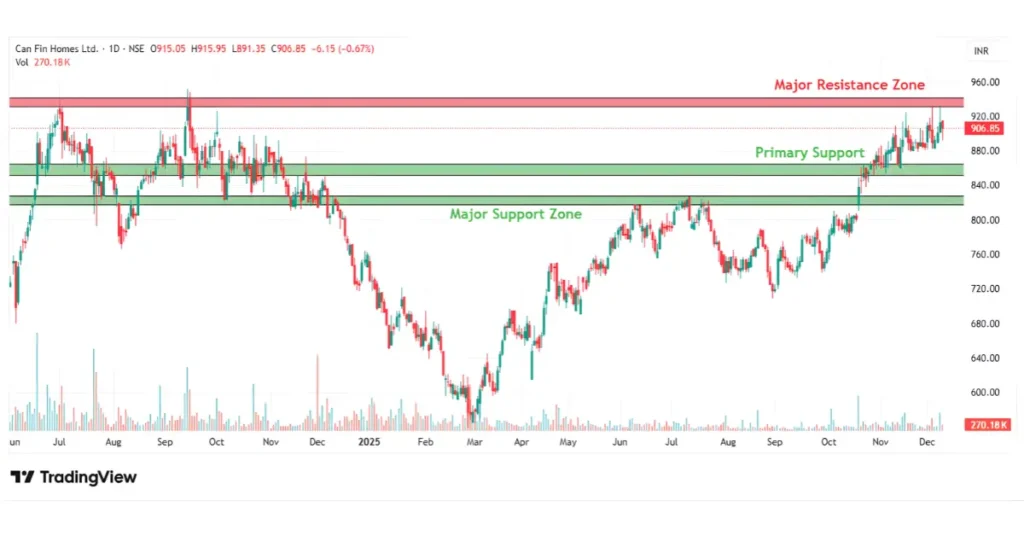
- 50 EMA and 200 EMA Analysis: On the daily time frame chart of Can Fin Homes, the 50 EMA is well above the 200 EMA. And the price is trading in a range much above this 50 EMA (₹900+), which means that the long-term trend is bullish and the short-term momentum is positive. If the price breaks down from above and the daily candle closes below this 50 EMA, then the upside momentum in the stock may weaken.
- Strong Support Level Analysis: Currently, there is a strong support zone at the level of ₹860 to ₹880, and along with it, the 50 EMA is also working as support at this level. If selling pressure comes and the price breaks this level, then the next major support zone is the level of ₹820 to ₹830. This support level is a strong institutional demand zone.
- Major Resistance Levels Analysis: Currently, the price is trading near its 52-week all-time high, which is also acting as a major resistance level which is the level at ₹930. This zone is the seller’s zone. The price may fall below this level, but if the price breaks this resistance with strong volume and closes the candle above this level, then a strong upside rally may start.
- RSI 14 Analysis: RSI is now at the level of 59, which does not mean it is in the overbought or oversold zone and is indicating a bullish trend. However, if RSI crosses 60–70, a fresh breakout rally may begin.
- Volume Analysis: Currently, the volume level is average, no big buyer entry is visible, and no big selling pressure is visible on volumes. However, if there is a spike in volume and the level of ₹930 breaks, then a strong rally starts.
| Indicator | Current Status | What It Means |
|---|---|---|
| Trend | Bullish | Long Term Bullish + EMA support |
| 50 EMA | Price Above 50 EMA | Short–term buyers control |
| 200 EMA | Price Above 200 EMA | Long–term trend positive |
| RSI 14 | 59–60 zone | Momentum healthy |
| MACD | Positive | Next leg needs volume |
| Support | ₹880–₹860 / ₹830–₹820 | Buyer accumulation zones |
| Resistance | ₹930 | Seller’s active zone if the break, uptrend starts |
Can Fin Homes Fundamental Analysis
Can Fin Homes’ latest Q3 FY2026 earnings result and financial performance Year-over-Year ( YoY) are discussed below.
Quarterly Earning Results (Q3 FY2026)
| Dec 2025 | Sep 2025 | Jun 2025 | Mar 2025 | |
|---|---|---|---|---|
| Sales | 1,073 | 1,049 | 1,020 | 999 |
| Financing Profit | 345 | 336 | 281 | 282 |
| Financing Margin% | 32% | 32% | 28% | 28% |
| Net Profit | 265 | 251 | 224 | 234 |
| EPS in Rs | 19.89 | 18.88 | 16.81 | 17.57 |
| Gross NPA % | 0.92% | 0.94% | 0.98% | 0.87% |
| Net NPA % | 0.49% | 0.50% | 0.54% | 0.46% |
(Source: Screener – Quarterly Results Data)
Financial Performance (YoY Results)
| TTM | Mar 2025 | Mar 2024 | Mar 2023 | |
|---|---|---|---|---|
| Sales | 4,054 | 3,879 | 3,523 | 2,742 |
| Financing Profit | 1,171 | 1,089 | 969 | 835 |
| Financing Margin% | 29% | 28% | 28% | 30% |
| Net Profit | 921 | 857 | 751 | 621 |
| EPS in Rs | 69.19 | 64.37 | 56.38 | 46.65 |
| Reserves | – | 5,041 | 4,317 | 3,621 |
| Borrowings | – | 35,051 | 31,863 | 29,068 |
(Source: Screener – Annual Financial Data)
Important Key Metrics
| Metrics | Values |
|---|---|
| Market Cap | ₹ 12,425 Cr |
| Stock P/E | 13 |
| Industry PE | 16 |
| PB Ratio | 2.37 |
| Sector PB Ratio | 2.45 |
| ROE | 18.2 % |
| ROCE | 9.34 % |
| Debt to Equity | 6.61 |
(Source: Screener – Key Metrics Data)
Brokerages Houses Ratings & Long-Term Opinion
According to credit rating agencies, Can Fin Homes is a financially strong housing finance company. Major rating agencies like ICRA, CARE have given the company AAA/Stable rating, which is creating positive sentiment for the company.
| Rating House | Rating | Key observations |
|---|---|---|
| ICRA | AAA (Stable) | Strong long-term debt security, good asset quality. |
| CARE Ratings | AAA+ | Strong financial profile, low credit risk. |
| Jefferies | Buy view, Target:₹1,050 | loan book recovery, profitability visibility, and long-term growth potential. |
| Mirae Asset Sharekhan | Buy view, Target: ₹1,040 | healthy fundamentals, asset quality positive |
| ICICI Direct | Buy view, Target: ₹1,000 | consistent growth, strong underwriting, RoA stability |
Can Fin Homes Peer Comparison
| Company | P/E | P/B | ROE | ROCE | Market Cap |
|---|---|---|---|---|---|
| Can Fin Homes Ltd | 13 | 2.20 | 18.2% | 9.34% | ₹ 12,425 Cr |
| Bajaj Housing Finance | 33.7 | 3.76 | 13.5% | 9.55% | ₹ 79,615 Cr |
| LIC Housing Finance | 5.40 | 0.77 | 16.0% | 8.93% | ₹ 29,802 Cr |
| PNB Housing Finance | 10.7 | 1.31 | 12.3% | 9.46% | ₹ 23,546 Cr |
Share Holding Pattern
| Dec 2025 | Sep 2025 | Jun 2025 | Mar 2025 | Dec 2024 | |
|---|---|---|---|---|---|
| Promoters | 29.99% | 29.99% | 29.99% | 29.99% | 29.99% |
| FIIs | 13.24% | 12.52% | 12.10% | 12.14% | 11.41% |
| DIIs | 24.70% | 23.88% | 24.53% | 24.66% | 28.14% |
| Public | 32.07% | 33.61% | 33.37% | 33.20% | 30.46% |
Can Fin Homes Latest News & Updates
- 19 January 2026: CAN Fin Homes’ Q3 FY26 results —the company’s Net Profit (PAT) increased 25% to ₹265 crore, and NII increased 22% to ₹421 crore. At the same time, Operating Profit was ₹351 crore and PBT was ₹341 crore, showing good growth over the previous year. Asset quality is also stable—Gross NPA remained unchanged at 0.92% while Net NPA decreased to 0.49%. Also, Loan Disbursement increased 45% to ₹2,727 crore during the quarter, and the total loan book increased 10% to ₹40,683 crore. (Source: business-standard.com)
- 12 December 2025: Can Fin Homes Board of Directors said that a board meeting will be held on 15 December 2025 to decide whether to declare an interim dividend for FY26. The record date for this potential interim dividend has been set at 19 December 2025. (Source: ET Now News Report)
Is Can Fin Homes a Good Buy For the Long Term? (Bull Case & Bear Case Explained)
Bull Case:
- Strong Support: Canara Bank backing, trust, liquidity support, and lower borrowing cost.
- Very Low NPA: GNPA historically <1%
- Large Branch Network: 240+ branches nationwide, growing presence in North & West India.
- Retail Loan Focus: Salaried borrower share is high (72%), risk profile is better.
- Loan Book Growth Visibility: FY26 ₹10,500 crore disbursement target + AUM ~12–13% growth guidance।
- Affordable Housing Demand: Government schemes, urbanisation, first-time buyer market are increasing steadily.
- Digital Adoption: e-verification, CKYC, AI analytics, faster loan approval and increased operating efficiency.
- Consistent Profitability: The company’s profit has grown at a CAGR of 26% in the last 10 years, 18% in 5 years, and 22% in 3 years.
- Undervaluation: The company’s P/E is 13.1, which is much lower than the industry PE of 17.0.
Bear Case:
- High competition: Competition is increasing for HDFC Ltd, LIC Housing Finance, PNB Housing, Bajaj Housing Finance and other NBFCs, fintech players.
- Low Promoter Holding: Canara Bank holds only 29.99% stake in this company, which is less than 50%, which increases the risk.
- South Dependency: About 72% of loans are in South India → any regional slowdown could impact.
- Borrowing Cost Rising: Cost of borrowing in FY24 has increased from 6.54% → 7.4%.
- Yield Compression Risk: Salaried borrower base is safe, but comparatively lower yield.
- Geographical Expansion Execution Risk: Growth may slow if North/West expansion scaling is not successful.
- Regulatory Risks: If RBI, NHB or the government changes any policy or adds a new policy, then the risk to the business increases, and revenue and profit may go down.
- Short-term Volatility: People build fewer houses during the rainy season, so pressure on profits may be seen during this time.
>> Read More: NTPC Green Energy Share Price Target 2025, 2026, 2030, 2040, 2050
Conclusion
Can Fin Homes, which does housing finance business, is very good because this business will never stop; rather, the demand for home buy/land buying will continue to increase in the future. The Indian government is also pushing this sector to grow. With Canara Bank’s support, the company can source loans at very low interest rates, which is a big advantage. The management is increasing the loan portfolio to grow the business, and is increasing the number of branches to do business in the rest of India. Although disbursement slowdown, rising borrowing cost, regional dependency and operational challenges in some states may create short-term volatility, in the long-term, the share may show good performance.
FAQ
What is Can Fin Homes?
Can Fin Homes Ltd is a housing finance company that provides home loans to middle-class, salaried and self-employed borrowers across India.
Is Can Fin Homes government or private?
It is a publicly listed private company promoted by Canara Bank, not a government company.
Is Can Fin owned by Canara Bank?
Canara Bank is a major shareholder, holding around 29.99% stake in the company.
What type of loans does Can Fin Homes offer?
It primarily offers housing loans, as well as mortgages, top-up loans, and non-housing loans for retail customers.
Does Can Fin Homes benefit from government schemes?
Yes, it benefits from demand created by PMAY and affordable housing programs.
What expansion plans does Can Fin Homes have?
It aims to open more branches, diversify its markets, and increase the share of self-employed borrowers.
Does the company face competition?
Yes, it competes with HDFC, LIC Housing, PNB Housing, SBI and other NBFCs.
What is the average home loan size in Can Fin Homes?
The average housing loan size at Can Fin Homes Ltd is approximately ₹25 lakhs.
What is the share price target of Can Fin Homes in 2026?
Based on business fundamentals and sector growth, the estimated 2026 share price target range may be around ₹868 to ₹1,175.
What is the share price target of Can Fin Homes in 2030?
Based on long-term expansion and rising housing demand, the estimated 2030 share price target range may be around ₹2,020 to ₹2,656.
What is the share price target of Can Fin Homes in 2040?
Digital lending adoption and business compounding potential, the projected 2040 share price range may be ₹4,849 to ₹6,010.
What is the share price target of Can Fin Homes in 2050?
If long-term and sector growth continue, the estimated 2050 share price target may be in the range of ₹9,300 to ₹12,155.
Disclaimer
This article analyses Can Fin Homes share price target, fundamentals, technical analysis and other topics, which are provided for educational purposes only. These are in no way investment advice, recommendations, or buy/sell instructions. We do not guarantee that the share price will increase or decrease. Every investment in the market is risky, and the actual behaviour of the market may change according to the company’s performance, economic conditions, policy changes and investor sentiment. So before investing, do your own research or consult a registered financial advisor. We (stockpricetarget.in team) are not responsible for your profit or loss.