Last Updated: 15 February 2026
Are you thinking of investing in SJVN shares? Many people are curious about what the price of this share could be in the future. In this article, we will discuss the possible SJVN share price target from 2026 to 2050. Along with this, the company’s business and fundamental aspects will be analysed in simple language, so that you can get a clear idea.
SJVN Share Price Target (2026 to 2050) – Quick Overview
| Year | Minimum Price | Maximum Price |
|---|---|---|
| 2026 | ₹68 | ₹136 |
| 2027 | ₹95 | ₹148 |
| 2028 | ₹112 | ₹169 |
| 2029 | ₹128 | ₹188 |
| 2030 | ₹152 | ₹239 |
| 2035 | ₹264 | ₹350 |
| 2040 | ₹376 | ₹548 |
| 2050 | ₹598 | ₹1,047 |
SJVN Ltd: Company Overview & Business Model (NSE: SJVN, BSE: 533206)
SJVN Limited is a government power generation company, whose full name is Satluj Jal Vidyut Nigam Limited. This company was formed on 24 May 1988. Initially, it was formed as a joint venture between the Government of India and the Government of Himachal Pradesh. Currently, SJVN is a listed company. The main function of this company is to generate electricity and supply it to different states in the country. In August 2024, SJVN was given Navaratna status. The company’s business is mainly divided into five parts, such as:
- Hydro Power Business
- Renewable Energy Business
- Thermal Power Business
- Power Transmission Business
- Power Trading Business
SJVN Share Price Today (LIVE Chart)
SJVN Share Price Target Analysis (2026-2050)
In this section, we will discuss the projected share price target 2026, 2027, 2028, 2029, 2030, 2035, 2040, and 2050 of Satluj Jal Vidyut Nigam Limited (SJVN) based on the company’s new project, business growth, government scheme, business model and many more.
SJVN Share Price Target 2026
The year 2026 is very important for SJVN because at this time, Unit 1 of the Buxar Thermal Power Project (1,320 MW, Bihar), which is already operational, and now Unit 2 (660 MW) is expected to be operational by January or February 2026. Also, Bikaner Solar Project (1,000 MW, Rajasthan), Khavda Solar Project 200 MW, Gujarat, may be operational in December 2026. When all these big projects start generating electricity, then the company’s income or revenue will continue to increase directly. According to our analysis, the estimated minimum share price of SJVN in 2026 can be between ₹68 and the maximum price can be ₹136.
| Month | Minimum Price | Maximum Price |
|---|---|---|
| January | ₹68 | ₹99 |
| February | ₹69 | ₹104 |
| March | ₹74 | ₹111 |
| April | ₹77 | ₹114 |
| May | ₹79 | ₹118 |
| June | ₹80 | ₹122 |
| July | ₹83 | ₹126 |
| August | ₹86 | ₹127 |
| September | ₹89 | ₹130 |
| October | ₹93 | ₹132 |
| November | ₹96 | ₹133 |
| December | ₹99 | ₹136 |
SJVN Share Price Target 2027
SJVN’s total installed capacity is now 3.5 GW, which can increase to 7.5 GW by 2027. The management has also informed that the company can make an estimated CapEx of 8,000 crore this year to further expand its business and create new projects. According to our analysis, the estimated minimum share price of SJVN in 2027 can be between ₹95 and the maximum price can be ₹148. ( Management Commentary Source: investing.com )
| Year | Minimum Price | Maximum Price |
|---|---|---|
| 2027 | ₹95 | ₹148 |
SJVN Stock Price Target 2028
The company’s revenue comes mostly from hydro power. So SJVN is expanding its portfolio by generating electricity from Thermal Power and expanding into renewable energy by starting wind projects, solar projects, Pumped Storage Projects (PSP), green hydrogen and green ammonia. This creates multiple revenue-generating sources for the company. According to our analysis, the estimated minimum share price target of SJVN in 2028 can be between ₹112 and the maximum price target can be ₹169.
| Year | Minimum Price | Maximum Price |
|---|---|---|
| 2028 | ₹112 | ₹169 |
SJVN Share Price Target 2029
This company works on the long-term Power Purchase Agreement (PPA) model. But what is this PPA model, and how does it work? It is a long-term written agreement. When SJVN builds a new power plant (solar or hydro), they sign an agreement with a large buyer, such as a government electricity distribution company. This agreement states that SJVN will supply electricity to that buyer at a fixed price for the next 25-35 years. As a result, the company has the advantage that before generating electricity, they know who will buy the electricity they produce and at what price. This guarantees the company a fixed income for the next 25-30 years.
According to our analysis, the estimated stock price of SJVN in 2029 could range between a minimum of ₹128 and a maximum of ₹188.
| Year | Minimum Price | Maximum Price |
|---|---|---|
| 2029 | ₹128 | ₹188 |
SJVN Share Price Target 2030
The company’s official goal is to achieve 25,000 MW of power generation capacity by 2030.
Meeting this huge target will massively boost SJVN’s sales and profits. The government has set a target of generating 500 GW of power from renewable sources by 2030. To meet this huge target, SJVN and other companies are getting work orders to build large solar and hydro projects. Also, SJVN’s business will show more growth due to the government’s net-zero carbon policy. So According to our analysis, the estimated share price target of SJVN in 2030 could range between a minimum price of ₹152 and a maximum price of ₹239.
| Year | Minimum Price | Maximum Price |
|---|---|---|
| 2030 | ₹152 | ₹239 |
SJVN Share Price Target 2035
By 2035, SJVN could become a major power supplier in South Asia, not only in India but also in countries like Nepal and Bhutan, through its hydro and renewable projects. Increased cross-border power trade will increase the company’s foreign exchange earning opportunities, which will further strengthen the company’s balance sheet. Also, the demand for electricity in India is increasing day by day, which will increase further by 2035. According to our analysis, the estimated minimum share price target of SJVN in 2035 can be between ₹264 and the maximum price can be ₹350.
| Year | Minimum Price | Maximum Price |
|---|---|---|
| 2035 | ₹264 | ₹350 |
SJVN Share Price Target 2040
The government is providing subsidies through various schemes for the production of green hydrogen, solar parks and non-fossil fuel, the most notable of which is the Production Linked Incentive (PLI) scheme. With these benefits, SJVN can multiply their business and profit. Also, as a result of the Renewable Purchase Obligation (RPO) policy of the Government of India, it is being made mandatory for the power distribution companies to purchase a certain amount of electricity from renewable energy, which is very good for the renewable power generation companies. According to our analysis, the estimated minimum share price target of SJVN in 2040 can be between ₹376 and the maximum share price can be ₹548.
| Year | Minimum Price | Maximum Price |
|---|---|---|
| 2040 | ₹376 | ₹548 |
SJVN Share Price Target 2050
When SJVN generates electricity without coal, they will earn ‘carbon credits’. These credits will be able to sell to companies that pollute more. This will be an additional source of income for the company. According to our analysis, the estimated minimum share price target of SJVN in 2050 can be between ₹598 and the maximum share price can be ₹1,047.
| Year | Minimum Price | Maximum Price |
|---|---|---|
| 2050 | ₹598 | ₹1,047 |
> Read More: Can Fin Homes Share Price Target 2026, 2030, 2040, 2050 Forecast
SJVN Technical Chart Analysis
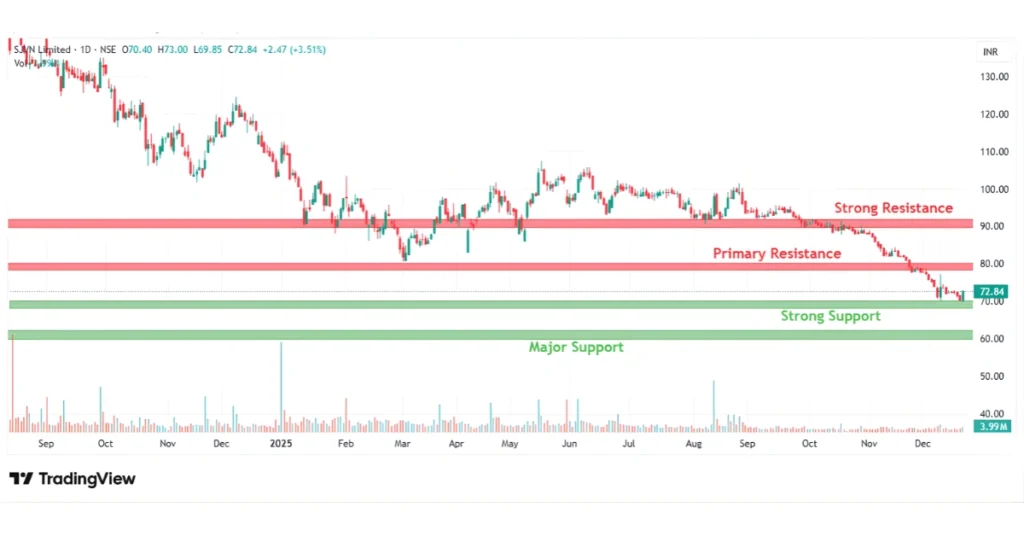
- 50 EMA and 200 EMA Analysis: According to the daily chart, SJVN stock is currently trading below both the 50 EMA and 200 EMA, which clearly indicates a bearish trend. The 50 EMA usually indicates a short-term trend, and the 200 EMA indicates a long-term trend. The current share price being below the 50 EMA means that the short-term momentum is still bearish, while being well below the 200 EMA means that the long-term trend is also bearish.
- Support Levels Analysis: The ₹68 to ₹70 level is a strong support zone on the daily chart. The price has taken support near this level several times, which shows that there is buyer interest here. Since this level is a 52-week low, panic selling is relatively less in this zone. However, if this support breaks and the candle closes below ₹68 on the daily chart, then the next major support will be the ₹60 to ₹64 level.
- Resistance Levels Analysis: The first primary resistance on the upside is at the ₹78 to ₹80 level, which is currently near the 50 EMA on the daily time frame. If the price reaches this zone, selling pressure may come. Above this, another major resistance level is at ₹90 to ₹92, where the 200 EMA is located. Until the price can sustain above ₹80 with strong volume, it is risky to expect a strong upside rally.
- RSI 14 Analysis: Currently, the Daily RSI (14) is around 35–36. It has moved slightly above the previous deep oversold zone (20–25), indicating a decrease in selling pressure in the short-term.
- Volume Analysis: Volume analysis shows that there was not much abnormal or panic volume during the recent decline. Similarly, the volume during the recent bounce is not very strong. This means that strong accumulation has not yet started in the market. Generally speaking, there is still uncertainty between buyers and sellers in the market.
- Trend: According to price action, SJVN stock is still in a clear bearish trend as per the daily chart. The price is continuously making lower highs and lower lows, which is a sign of a downtrend.
| Indicator | Current Status | What It Means |
|---|---|---|
| Trend | Bearish | Downtrend is ongoing |
| 50 EMA | Price down | Short-term weak |
| 200 EMA | The price is much lower | Long-term weak |
| RSI 14 | 36 | Bounce is possible |
| MACD | Bearish | Momentum negative |
| Support | ₹68 – ₹70/ ₹60 – ₹64 | Strong & Major Support |
| Resistance | ₹78 – 80 / ₹90 – ₹92 | Supply zones |
SJVN Fundamental Analysis
SJVN’s recent Q3 FY26 results and financial performance year-over-year are discussed below:
SJVN Latest Quarterly Earning Results (Q3 FY26)
| Dec 2025 | Sep 2025 | Jun 2025 | Mar 2025 | |
|---|---|---|---|---|
| Sales | 1,082 | 1,032 | 917 | 504 |
| Operating Profit | 773 | 860 | 707 | 241 |
| OPM% | 71% | 83% | 77% | 48% |
| Net Profit | 224 | 308 | 228 | -128 |
| EPS | 0.57 | ₹0.78 | ₹0.58 | ₹-0.32 |
Financial Performance (YoY Results)
| TTM | Mar 2025 | Mar 2024 | Mar 2023 | |
|---|---|---|---|---|
| Sales | 3,536 | 3,072 | 2,579 | 2,938 |
| Operating Profit | 2,581 | 2,223 | 1,843 | 2,273 |
| OPM% | 73% | 72% | 71% | 77% |
| Net Profit | 632 | 818 | 911 | 1,359 |
| EPS in Rs | ₹1.61 | ₹2.09 | ₹2.32 | ₹3.46 |
| Reserves | N/A | 10,249 | 10,141 | 9,930 |
| Borrowings | N/A | 27,025 | 20,323 | 14,059 |
(Source: Screener – Annual Financial Data)
Important Key Metrics
| Metrics | Values |
|---|---|
| Market Cap | ₹30,130 Cr |
| Stock P/E | 47.6 |
| Industry PE | 27.1 |
| PB Ratio | 2.07 |
| Sector PB Ratio | 2.81 |
| ROE | 5.81% |
| ROCE | 4.91% |
| Debt to Equity | 2.03 |
(Source: Screener – Key Metrics Data)
SJVN Peer Comparison
| Company | P/E | P/B | ROE | ROCE | Market Cap |
|---|---|---|---|---|---|
| SJVN | 47.6 | 2.07 | 5.81% | 4.91% | ₹30,130 Cr |
| NHPC | 24.0 | 1.84 | 7.53% | 7.42% | ₹75,810 Cr |
| NLC India | 13.8 | 1.80 | 14.5% | 10.5% | ₹35,955 Cr |
| NTPC | 14.6 | 1.83 | 12.1% | 9.95% | ₹3,51,989 Cr |
| JSW Energy | 36.0 | 2.85 | 7.41% | 6.49% | ₹83,419 Cr |
Share Holding Pattern
| Dec 2025 | Sep 2025 | Jun 2025 | Mar 2025 | Dec 2024 | |
|---|---|---|---|---|---|
| Promoters | 81.85% | 81.85% | 81.85% | 81.85% | 81.85% |
| FIIs | 2.69% | 2.55% | 2.52% | 2.49% | 2.42% |
| DIIs | 3.99% | 4.32% | 4.10% | 4.20% | 4.10% |
| Public | 11.47% | 11.27% | 11.54% | 11.46% | 11.63% |
Is SJVN good for long-term investment? (Bull Case & Bear Case Explained)
Bull Case:
- Obtaining loans, acquiring land, and securing tenders as a PSU company is easier than for others.
- Most of the projects are under construction. Once these projects start, the company’s sales and profits may start increasing.
- Most of the company’s electricity is sold through long-term PPAs, resulting in guaranteed income.
- Hydropower projects, once operational, provide stable income at low cost for 30–40 years.
- By entering solar, wind, pumped storage, and thermal, the business is not dependent on a single source, resulting in lower risk.
- Electricity is a sector whose demand is unlikely to decline in the long term, so long-term business visibility is good.
- Most of SJVN’s customers are state-owned power distribution companies and other PSU companies, so the risk in this business is low.
- Sep 2025 quarter FIIs and DIIs have increased their stakes slightly.
Bear Case:
- Currently, the company has high debt and is paying high interest, which is putting pressure on profits.
- It is a big challenge to survive in competition with big private sector players like Adani Green or Tata Power.
- If the government takes any tough decisions on electricity tariffs or subsidies in the future, it could have a negative impact on the company’s profits.
- Power projects cost a lot of money at the beginning, but it takes a long time for the income to start coming in.
- When carrying out a project in Nepal or Bhutan, political instability or poor relations between the two countries may increase the risk to the project’s work.
- If water flow in rivers decreases due to irregular rainfall or melting glaciers, there is a risk of reduced production from hydro power projects.
- SJVN’s P/E ratio is higher than the industry P/E.
- Some renewable and hydro projects are facing delays due to land acquisition and environmental clearances.
> Read More: NTPC Green Energy Share Price Target 2025, 2026, 2030, 2040, 2050
Conclusion
SJVN is a Government-owned power company whose business is mainly dependent on hydro and renewable energy. The company is currently focusing on new projects and renewable energy, which can help increase revenue in the future. However, there are also some risks such as debt pressure, project delays and profit fluctuations. So while SJVN shares have the potential to improve gradually in the future, it is not a stock that will give very fast or high returns.
FAQ
Is SJVN a Government company?
Yes, SJVN is a public sector undertaking (PSU) company. The Government of India and the Government of Himachal Pradesh are the major shareholders.
What does the SJVN company do?
SJVN is primarily in the business of power generation. It generates and supplies electricity through hydro, solar, wind, and thermal power projects.
Is SJVN a Navratna company?
Yes, SJVN is a Navratna PSU, which gives the company more freedom in making financial and project decisions.
What is the future of SJVN?
In the long term, SJVN’s future is linked to the growth of the power and renewable sectors. Business could gradually improve as new projects come on stream.
Why is SJVN stock falling?
High debt, project delays, profit fluctuations, and overall market weakness have put pressure on the share price.
Is SJVN a debt-free company?
No, SJVN is not debt-free; the company has high debt. The company has debt for new major projects, but it is mainly taken for growth capex.
What is the target price of SJVN in 2026?
SJVN’s share price is expected to be between a minimum of ₹68 and a maximum of ₹136 in 2026.
What is the share price target of SJVN in 2030?
SJVN’s share price is expected to be between ₹152 to ₹239 in 2030.
Disclaimer
We do not guarantee that the SJVN share price target given in this article will increase or decrease in the future. The stock market is always changing, and prices may fluctuate depending on market conditions. The information and analysis provided here are for educational purposes only and are not investment advice. This analysis is based on the current fundamentals and business conditions of the company. Do not make any investment decisions based on the information provided by us. Please consult your own financial advisor before investing. We are in no way responsible for your profits or losses.